
AI readiness assessment: what to answer before you buy anything
Being ready for AI comes down to one expensive problem, the data behind it and the person who lives with it. What to answer before you buy anything.

On this page
The readiness report scores the company on data, people, technology and governance, and it ends with a recommendation to "start with a pilot". Nobody in the room can say what the pilot should fix.
Being ready for AI comes down to one problem that costs the company money every month: the data behind it, and the person who lives with it. If the board keeps asking about AI and every demo looks good, the bigger risk is paying for a project before anyone agrees on what it should change.
What does an AI readiness assessment measure?
Most score the company on four or five areas (data, technology, people, governance, sometimes culture) and roll them into one number or a level on a maturity scale. Those areas matter. The weak point is the average.
A company can score well on data overall while its vendor invoices still arrive in three inboxes and the rules for approving them live in one person's head. The score calls that company fairly ready. It doesn't say ready for what, and that's the question that decides whether the first project pays.
Why haven't most companies seen a return from AI yet?
The companies that do see a return put most of their effort into the process and the people around the technology. In BCG's 2024 survey of 1,000 executives, 74% of companies had yet to show tangible value from AI, and the ones that did spent roughly 10% of their resources on algorithms, 20% on technology and data, and 70% on people and processes (BCG, October 24, 2024).
Two years later the picture hasn't moved much. In PwC's 2026 Global CEO Survey of 4,454 CEOs, 56% had seen neither more revenue nor lower costs from their AI investments, and 12% had seen both (The Register, January 20, 2026).
That matches what I've seen in our projects. The ones that paid off started from a job that was already costing money, and the technology came in as one step of that job. So a useful readiness review starts from one process.
Which problem should come first?
The one that costs money every month, that a named person feels, and that comes back on a schedule. If a problem fails any of those three, it can wait.
Two examples from our projects, told without names. At a manufacturer, vendor invoices waited on the one or two people who knew which account each belonged to and who approved above which amount; when they were away, payments slipped and vendors called. At a distributor, the sales reps could reach only part of the stores they served before those stores placed their next season's orders, so some of those orders went to whoever called first.
Both started as a sentence someone could say in a meeting, about late payments in one case and lost orders in the other. AI came up later, as one step.
Put a number on your own version with data you already track: invoices paid after their due date last quarter, orders a customer placed elsewhere, stock that sat on the shelf. If nobody can put a number on it, the problem may be real, but it isn't the first one.
Is our data ready for AI?
The data behind that one problem has to be ready. The rest of the company's data can wait.
A client's leadership asked us for a company-wide assistant that could answer questions about the business. Before anyone built it, their own team raised the question that mattered: do the numbers underneath agree with each other? An assistant answers from what it's given. In practice: when two reports disagree on last month's sales, the answer comes from one of them and reads as certain (and nobody enjoys finding out that sales and finance keep two versions of last month).
You may be thinking the data has to be cleaned up across the board first. For a first project it doesn't. When the data behind the problem is already in one place, as the sales history was in one of our projects, the first build is small. If it's scattered across spreadsheets, inboxes and a system nobody updates, bringing it together is part of the job, and part of the price.
So the data question is narrow: for this one problem, where does the data live today, who keeps it current, and do any two sources disagree?
Is our team ready?
The team is ready when the person who owns the problem has time to check what the first version gets wrong.
IBM's 2026 CEO Study of more than 2,000 CEOs found that 86% believe their people are ready for AI, while only 25% of workers use it regularly in their job; 83% of the CEOs said success depends more on people adopting it than on the technology (IBM, May 8, 2026).
In our projects the deciding factor was one person: the controller or the sales lead who lives with the problem. In a review like the one below, their part is a 45-minute session to keep, drop or dig into what the records show, plus some follow-up. Once something is built, it's regular time to check the first outputs and say what's wrong. When that person is too stretched to look, the project waits, whatever the score says.
What should a readiness review produce?
A page you can act on, more than a score: one problem in a sentence, what it costs in your own numbers, where the data lives, the rules people follow today, the owner, and the smallest first piece.
AI readiness score | What you need before you buy | |
|---|---|---|
Question answered | How ready is the company overall? | Ready for which problem? |
Data | A rating for the whole company | Where the data behind one problem lives, and who keeps it current |
People | Skills and culture, averaged | The person who owns the problem, and time to review |
Rules | Governance policies | The rules people follow today: who approves, above which amount, the exceptions |
Output | A number or a level | One problem, its cost in your numbers, a first piece small enough to check |
This is the order we go in.
Agree which processes to look at, and sign off access to their records before anyone reads anything.
Read 30 to 60 days of real activity for each one: the shared AP inbox, the approval tracker, the order desk inbox. Counts of what repeats replace opinions about it.
Sit with the person who owns each process to keep, drop or dig into each candidate. The records show the repetitive work people stop noticing; they miss the judgment calls, so the conversation stays.
Check every candidate against the records again before it goes in front of you, and write down the rules people follow today, including the exceptions.
Pick one problem to build first, and keep its count as the baseline, so the same records can show whether it dropped after go-live.
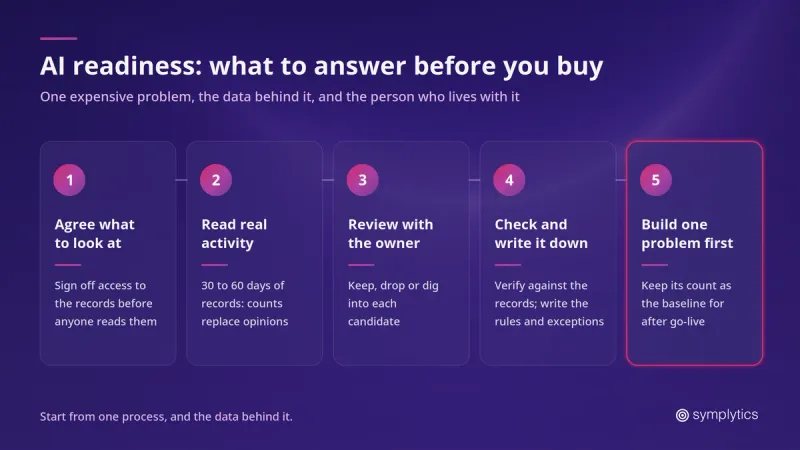
Step 4 often shows that a written rule does the job for most of the process, and AI is needed for one step at most. As Luciano, our founder, puts it: "AI is not the end goal. It's just a node in the process."
When is a company not ready for AI?
When it can't name the problem yet. Until it can, any tool it buys gets judged against the vendor's demo instead of against a cost the company knows.
Two other cases are worth naming. If the rules for a process live only in two people's heads and they disagree, the first job is writing them down and agreeing on them. If the data behind the problem exists only on paper or in personal inboxes, bringing it together comes first, and it belongs in the budget from day one.
In each case that work is the first step of the project, and it has an end you can see.
Where to start
Before your next meeting about AI, write one sentence: the problem, what it cost last quarter in your own numbers, and who lives with it. If you can write it, a free intro call is a good place to test it against the data you already have. Our use cases show where other companies started.
Questions
Is a free online AI readiness quiz worth taking? It shows you the areas assessments look at. It won't name your expensive problem, and that's what decides the first project.
What if we have several expensive problems? Start with the one whose data is already in one place and whose owner has time to review. The second one is easier once the first is running.