What a company brain is, and why your AI agents need one
Your AI agents only know the world in general. A company brain is what your people know about how you work, written down where systems can use it, with walls between departments.

On this page
Ask an AI tool which account a vendor invoice goes to, and it gives you a confident answer. Ask the person who has run your payables for years, and you get the right one: it depends on the vendor, on whether it's inventory, and on whether the early-payment discount applies.
That gap is what a company brain closes. A company brain is what your people know about how your company works (the rules, the exceptions, who approves what), written down where your systems can use it. AI agents need one because the model only knows the world in general: it guesses well, but it can't know your company unless you give it that.
If you've sat through an AI demo this year that worked beautifully on the vendor's sample data and fell apart on yours, this is the reason.
What is a company brain?
It's the written-down version of how your company actually runs, kept somewhere your systems can read it and act on it.
The term got loud this spring, when Y Combinator put "Company Brain" on its list of ideas it wants startups to build. Tom Blomfield, the partner who wrote it, describes the problem as know-how scattered across people and work systems, and the fix as gathering it, keeping it current and turning it into instructions an AI can follow. He also keeps it separate from a company search box or a chatbot over your documents. (Y Combinator, Requests for Startups, Summer 2026)
Two words come up a lot around it. A knowledge graph is a map of how things in your company relate: this vendor goes to that account, this approver signs above that amount. An ontology is the agreed list of what those things are called and what they mean, so "customer" means the same thing in sales and in finance. (If two of your departments can't agree on what a customer is, you already know which part is hard.)
You don't need to build either one to follow the idea. They're the names for turning what your people know into something a system can use.
What is an AI model, really?
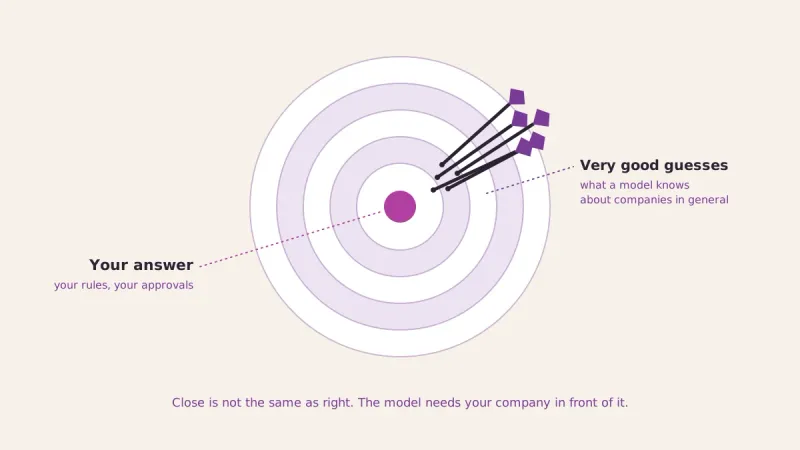
A very good guesser. A language model has read an enormous amount of text and learned which word is most likely to come next. Ask it a question and it builds the answer one likely word at a time. That's why it writes well about almost anything, and why it sounds just as sure when it's wrong.
What looks like reasoning is pattern-matching on everything it has read. It knows how invoices work in general. It has never seen your approval chain. Put it in front of your payables and it fills the gap with the most likely answer for a company like yours, which isn't always the right answer for yours.
MIT researchers found the same thing looking at companies that piloted AI. They put the main barrier on learning: most of these systems don't keep feedback or adapt to the company's context, so they don't get better with use. (MIT Project NANDA, "The GenAI Divide", July 2025, as reported by Virtualization Review)
Give the model your rules, and it works from your rules.
Why is the model the easy part?
Because you can rent it, and so can everyone else. The models get better every few months. Your competitor can use the same one you use, starting tomorrow. What they can't get is how your company decides which vendor gets paid early, or which customer gets a call when their orders slow down.
McKinsey’s October piece for CEOs turns this into a rule: “Own the context; rent or replace the technology.” (McKinsey, “The AI operating system: A new way for CEOs to run the enterprise”, October 13, 2026) That’s my position too. Keep what your people know in a place your company owns, in a form you can move, and treat the model like electricity. If a better one comes out next quarter, you plug it in and your rules stay where they are. The same article adds a warning worth repeating: if you let the model providers train on your data, your company’s brain slowly leaks into theirs.
The numbers show why. In McKinsey’s 2026 State of AI survey, 40% of respondents at companies with more than $1 billion in revenue said they had scaled AI agents, yet only 6% said AI brought in at least 5% of their EBIT, about the same as the year before (same McKinsey article). Plenty of agents, not much to show for them. Two years earlier, BCG found that the companies getting value from AI put 10% of their effort into algorithms, 20% into technology and data, and 70% into people and processes. (BCG, October 24, 2024)
You may be thinking your company is too small for this to matter. In my experience it works the other way: in a company of 200 people, the rules usually live in fewer heads. That makes them quicker to write down, and riskier to lose.
What actually goes into a company brain?
The rules your experienced people apply without thinking about it, and the exceptions they remember.
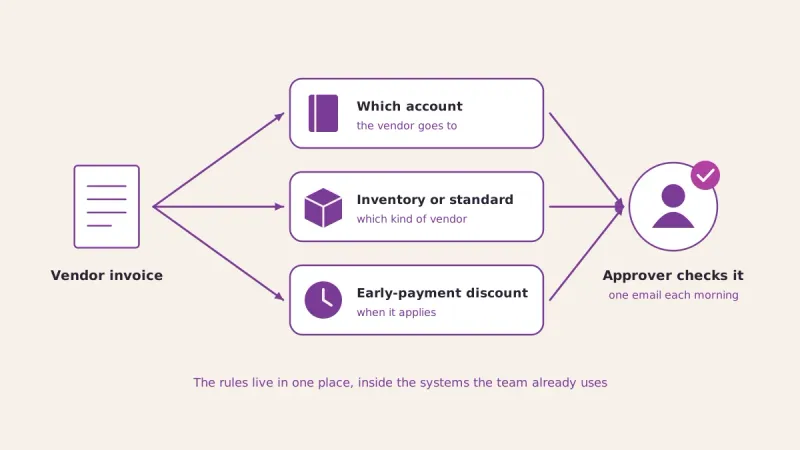
Here's one from a project of ours with a manufacturing client. Their vendor invoices ran on three rules that lived in a few people's heads: which account a vendor goes to, whether it's an inventory or a standard vendor, and when an early-payment discount applies. On top of that, whoever handled an invoice looked up the approval hierarchy by hand.
We moved the rules and the approvals into one place, inside the systems they already had. A person still checks every invoice, and the ERP's duplicate check stays on. Each morning, an approver gets one email: you have one invoice to look at, click here. The technology was the easy part. The hard part was the people who approve invoices. And when experienced people left, the process kept working and nobody had to make an emergency hire.
Larger companies are doing the same thing. In the same McKinsey article, a US manufacturer starting on pricing and planning wrote down business rules and know-how that had lived in spreadsheets or in employees’ heads, and had its first version running in about 16 weeks.
Three rules and one approval chain don't sound like much. But they're exactly what an AI agent would get wrong on its own, and exactly what walks out the door with the people who carry them.
Who gets to see what?
Not everyone should see everything, and the brain has to know that. Picture a sales rep asking the company's assistant about a customer's discount and getting back, in the same answer, a piece of the decision tree HR uses for promotions. Nobody meant to share it. It was in the brain, with no wall around it.
So the knowledge is split by department, with walls between the parts. Sales sees the sales brain, and HR's stays with HR. The CEO sees across all of them, because that's the job.
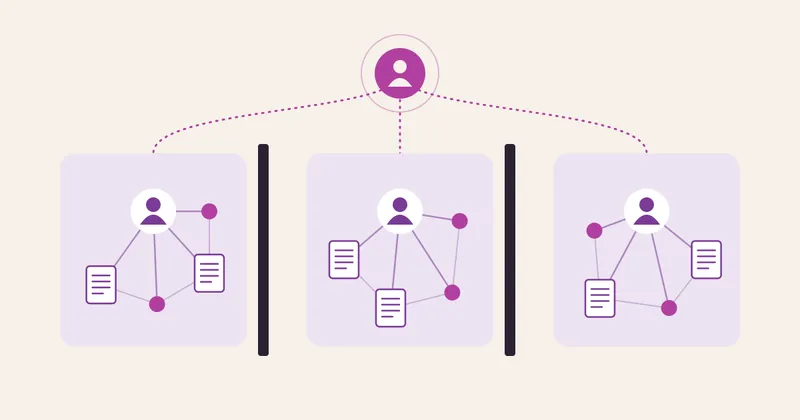
Each part also needs a named owner who keeps it current, because rules change: a new approver, a new threshold, a vendor that moved to another account. And it has to be observable. When an agent gives an answer, you should be able to see which rules and documents it used, or you can't trust it and you can't fix it when it's wrong.
Governance is the part a demo skips. It's also the part that decides whether you'll let an agent near real work.
Where does a company start?
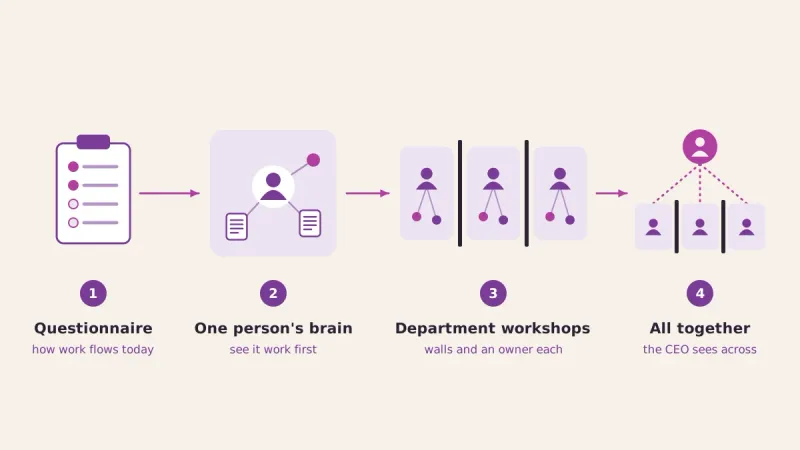
With one person, before any department. This is the order we work in:
A questionnaire, to understand the business: how work flows, what's written down today and what lives only in people's heads.
One person's brain first, usually the CEO or whoever is championing the idea. They use it on their own work and see what it does with their rules, before anyone else has to change how they work.
Workshops with each department, to get their rules, exceptions and approvals out of people's heads and into their part of the brain, with its walls and its owner.
Then we bring the departments together, so the CEO can see across, and an agent can work on a process that crosses two teams.
Why one person first? People trust what they've watched work on their own job. A company-wide rollout on day one asks everybody to believe in it before anybody has seen it.
If your first thought is "our knowledge isn't written down anywhere", that's where most companies start. The workshops are where it gets written down, by the people who already know it, in their own words.
Where to go from here
Pick one process where a wrong answer would cost you, and ask who in the company knows how it really works. That person is the first page of your company brain, and whatever gets written down stays yours: you own everything we build.
Our use cases show other processes we've worked on. And if you're wondering what a company brain would hold in your company, a free intro call is the easiest place to start.