Turning institutional knowledge into rules your company owns
When experienced people leave, the rules they carry go with them. How to turn what they know into rules in a system your company owns, so the process keeps running.

On this page
- What is institutional knowledge in a company like yours?
- What happens to a process when that person leaves?
- Why don't handover notes and documentation keep it?
- What does it look like when the rules live in a system you own?
- Which knowledge can become a rule, and which still needs a person?
- How do you get the rules out of people's heads?
- When is writing the rules down not enough?
- Where to start
- Questions
The AP lead gives notice, and by the end of the week the questions have started. Which account does this vendor go to? Who approves above that amount when the controller is away? Why does this supplier's invoice always get split three ways?
That's institutional knowledge: what your experienced people know about how the work actually gets done, and that no system holds. Most of it can become rules written in a system your company owns, so the process keeps running when they leave. The rest is judgment, and that part still needs a person.
What is institutional knowledge in a company like yours?
It's the working rules of the business that live in people instead of systems. In finance and operations it looks like this: which account each vendor goes to, which vendors are inventory and which are standard, when an early-payment discount applies, who approves above which amount and who covers when they're out.
Tribal knowledge is the part held by one or two people and never written down, and it's the part at risk. In a 2018 survey of about 1,000 US workers, 42% of institutional knowledge was unique to the person's role and not shared with coworkers (HR Dive, July 18, 2018). The survey was sponsored by a company that sells knowledge-sharing software, so read it as a direction more than a measure of your team.
What happens to a process when that person leaves?
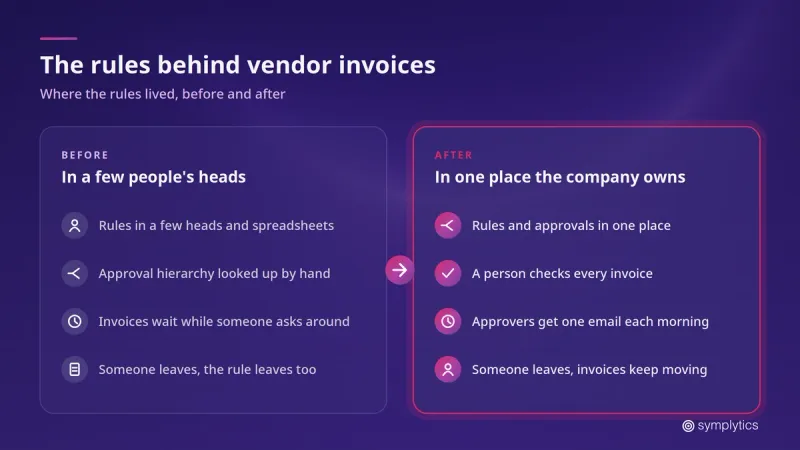
It slows down at the exact points only they understood. In one of our projects, the approval hierarchy for vendor invoices was looked up by hand for every invoice, and the rules for coding them sat in a few people's heads and spreadsheets. As Luciano, our founder, wrote about that client: "When someone left, it left with them."
The cost shows up as invoices waiting while someone asks around, discounts missed because nobody remembered the terms, and in the worst case an emergency hire to cover what nobody else knew. On a CFO forum, one finance leader described an approval stuck with someone who had left the company six months earlier.
Why don't handover notes and documentation keep it?
Most advice on institutional knowledge says to document it: process manuals, handover notes, mentoring, a knowledge base. All of that helps a new person learn. The trouble is that a document nobody uses day to day drifts away from how the work is done, and nobody notices until the person who knew the difference is gone.
What we've seen work is different: the rule goes into the system that runs the process, so it's used on every invoice or order. When a rule is wrong, someone notices that week, because the process stops on it.
What does it look like when the rules live in a system you own?
At a manufacturer we worked with, the company paid every month for invoice software while someone still typed every invoice in by hand. The rules that decided where an invoice went (which account, inventory or standard vendor, whether an early-payment discount applied) lived with a few people.
We moved the rules and the approval hierarchy into one place the company owns. A person still checks every invoice, and the accounting system's own duplicate check stays on. Approvers get one email each morning with what's waiting for them, so nobody had to learn a new tool. Now when someone on the team changes, invoices keep moving and nobody has to make an emergency hire.
Luciano's summary of the project: "The technology was the easy part. The hard part was the people who approve invoices." Our use cases show other processes we've worked on.
Which knowledge can become a rule, and which still needs a person?
A rule is anything someone could explain the same way twice. Judgment changes with the situation. Both sit in the same person's head, and only the first should move into a system.
Can be written as a rule | Stays with a person |
|---|---|
Which account a vendor goes to | Whether a supplier's price increase is acceptable |
Who approves above which amount, and who covers when they're out | How to handle a dispute with a long-time supplier |
Which vendors are inventory and which are standard | An invoice that fits no rule |
When an early-payment discount applies | Whether to make an exception for a key customer |
The system applies the rules and prepares the work. A person decides the exceptions.
How do you get the rules out of people's heads?
This is the order we go in.
Pick one process that would stop if one person were out for two weeks (our article on AI readiness covers how to choose which problem comes first).
Look at real cases from the last 30 to 60 days, more than at a description of the process. Every exception in the records is a rule someone knows.
Sit with the people who hold the rules, and write each one down with its exceptions and who backs it up.
Put the rules in one place the company owns, where the process reads them every day.
Name who updates a rule when it changes, and keep a person on every exception.
Step 3 is where most of the time goes. The people who know the rules are usually the busiest people on the team, and many of the rules have never been said out loud.
When is writing the rules down not enough?
Writing rules down doesn't settle a disagreement. If two people do the same task differently, the first job is agreeing on one rule, and that conversation happens before anything is built. It doesn't fix a bad process either: written down, a bad rule stays bad, so fix it while you're writing it.
And if the person leaves next week, there isn't time for the whole list. Start with the questions that would stop the process the day after they go.
Where to start
Ask one question this week: which process would stop first if one person were out for two weeks? List what only that person knows. If the list is longer than you'd like, our use cases show how we've moved other processes out of people's heads, and a free intro call is a good place to start on yours.
Questions
What's the difference between institutional knowledge and tribal knowledge? Institutional knowledge is everything a company knows about how it works, written down or not. Tribal knowledge is the part held by a few people and never written down, the part a resignation can take with it.
Do we need new software to keep it? Not necessarily. In the project above, the accounting system stayed and approvers kept working from their email. What changed is where the rules live.